
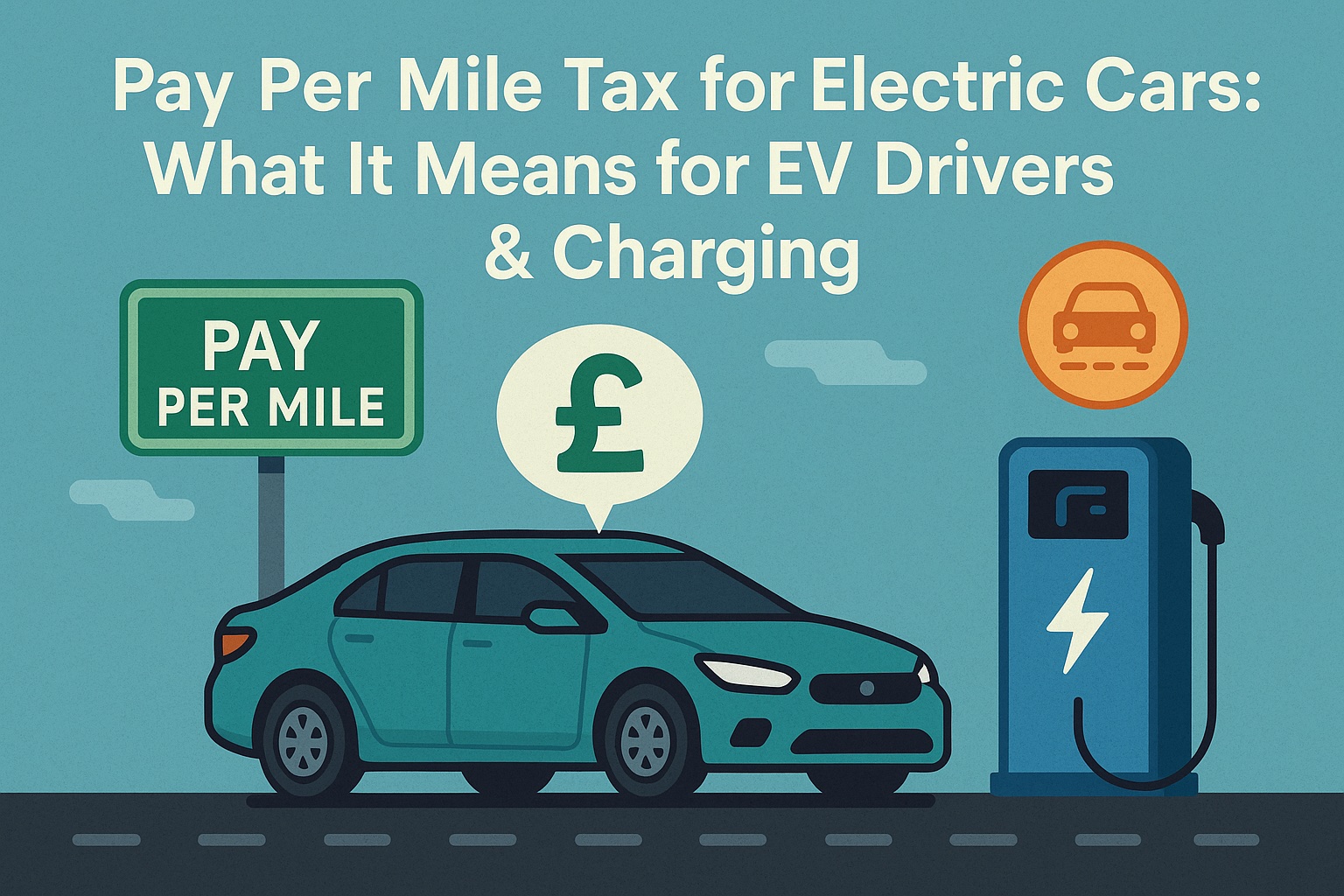
The UK Government has confirmed plans to introduce a pay per mile tax that will apply only to fully electric cars and plug-in hybrid vehicles, starting in April 2028. Petrol and diesel drivers will continue to pay fuel duty at the pump and the usual Vehicle Excise Duty (VED); they are not included in this new mileage-based charge.
For EV owners and anyone considering switching, understanding how the new pay per mile car tax works – and how electric vehicle chargers can still keep running costs low – is essential.
What Is the Pay Per Mile Tax (eVED)?
The new system is officially called Electric Vehicle Excise Duty (eVED) – a pay per mile road tax for:
- Battery electric vehicles (BEVs)
- Plug-in hybrid electric vehicles (PHEVs)
From 1 April 2028, EV drivers will pay 3p per mile, while plug-in hybrid drivers will pay 1.5p per mile.
The goal is to replace some of the fuel duty that’s currently paid by petrol and diesel drivers, while still keeping EV running costs significantly lower overall.
Key point: Petrol and diesel cars are not charged under this pay per mile tax. They continue to contribute through fuel duty and standard VED.
How Will the Pay Per Mile Car Tax Work?
The pay per mile tax is designed to slot into the existing VED system, rather than using trackers or black boxes.
Current proposals state that:
- Drivers will estimate their annual mileage when they tax their EV or PHEV.
- The charge will be added alongside standard VED.
- Mileage will then be checked at each MOT (or via a mileage check appointment for newer cars without an MOT).
- If there’s a big difference between estimated and actual mileage, the bill can be adjusted.
This means the pay per mile car tax stays simple, avoids constant GPS tracking, and uses mileage readings that are already routinely recorded.
How Much Will Pay Per Mile Road Tax Cost EV Drivers?
At 3p per mile for EVs and 1.5p per mile for PHEVs, the cost is still lower than the fuel duty effectively paid by petrol and diesel drivers, which averages around 6p per mile.
Example: 8,000 miles per year
- Battery electric car (BEV):
- 8,000 miles × £0.03 = £240 per year
- Plug-in hybrid (PHEV):
- 8,000 miles × £0.015 = £120 per year
For comparison, a petrol driver covering the same distance could easily pay around double that in fuel duty alone, on top of fuel and maintenance costs.
Why EVs Still Make Sense Under Pay Per Mile Tax
Even with the new pay per mile tax, EVs can still be cheaper to run than petrol and diesel cars – especially if you use home or workplace electric vehicle chargers.
Savings with Home EV Charging
Installing a dedicated electric vehicle charger at home allows you to:
- Charge at off-peak electricity rates, often much cheaper than public rapid chargers
- Take advantage of EV-specific tariffs from energy suppliers
- Avoid paying a premium every time you use public charging networks
Workplace and Commercial Chargers
For businesses running company cars or vans:
- Workplace chargers let staff charge during the day at predictable costs
- Fleet mileage can be monitored and forecast more accurately under the pay per mile system
- The business can still benefit from reduced fuel spend and lower maintenance compared to ICE fleets
How Pay Per Mile Road Tax Affects Plug-In Hybrids
Plug-in hybrids sit in the middle ground:
- They pay 1.5p per mile under eVED
- They still pay fuel duty on any petrol or diesel used
- The lower rate recognises that PHEVs split mileage between electric and combustion power
For drivers who regularly charge and use EV mode for short journeys, the blended cost can still be very attractive – but installing home or workplace electric vehicle chargers becomes even more important to squeeze maximum value from the PHEV’s electric range.
What Drivers Should Do Now
With pay per mile tax on the horizon, EV and PHEV drivers can start preparing:
- Understand your mileage
Look at how many miles you typically drive per year – that will determine your future eVED bill. - Plan for home or workplace charging
Installing electric vehicle chargers now helps you lock in lower energy costs before the system goes live. - Review tariff options
EV-friendly energy tariffs and off-peak rates can offset much of the new pay per mile charge. - Stay informed
Government guidance, consultation documents and motoring organisation advice will continue to refine the details as 2028 approaches.
Contact us for a free consultation if you would like to learn more about how the changing costs will affect your business
Pay Per Mile Tax – Frequently Asked Questions
1. Does the pay per mile tax apply to petrol and diesel cars?
No. The new pay per mile tax (eVED) only applies to fully electric vehicles and plug-in hybrids. Petrol and diesel vehicles continue to pay fuel duty at the pump and normal VED.
2. When will the pay per mile car tax start?
The mileage-based pay per mile car tax is scheduled to start from 1 April 2028, applying when EV and PHEV owners renew their VED.
3. How much will I pay per mile as an EV driver?
- Battery electric cars (BEVs): 3p per mile
- Plug-in hybrids (PHEVs): 1.5p per mile
These rates may be uprated in future in line with inflation, just like traditional fuel duty and VED.
4. Will there be a tracker fitted to my car?
No. Current proposals do not involve GPS tracking or black boxes. Instead:
- You estimate your mileage when you tax the vehicle
- Your actual mileage is checked at MOT or a mileage check appointment
- Adjustments can be made if there’s a large difference
5. Will pay per mile road tax make EVs more expensive than petrol cars?
In most cases, no. While the pay per mile road tax adds a new cost for EVs and PHEVs, they still avoid fuel duty and generally enjoy:
- Cheaper “fuel” (electricity vs petrol/diesel)
- Lower servicing and maintenance costs
- Potential access to cheaper tariffs when using home electric vehicle chargers
For many drivers, especially those who can install a home charger, EVs should remain cheaper to run overall.
6. Does the pay per mile tax apply to electric vans and company cars?
Yes, electric company cars and electric vans will also fall under eVED, with mileage-based charges applying much like private EVs. Businesses may need to report mileage for fleet vehicles and factor it into their running costs – another reason why workplace EV charging and smart charge management are so important.
7. Will I still save money by installing an EV charger at home?
In most cases, yes. A dedicated home EV charger lets you:
- Charge at cheaper off-peak rates
- Avoid expensive public rapid chargers for most journeys
- Keep your total cost per mile (electricity + eVED) below that of petrol or diesel driving
For many households, installing an electric vehicle charger is still one of the most effective ways to control motoring costs under the new tax system.